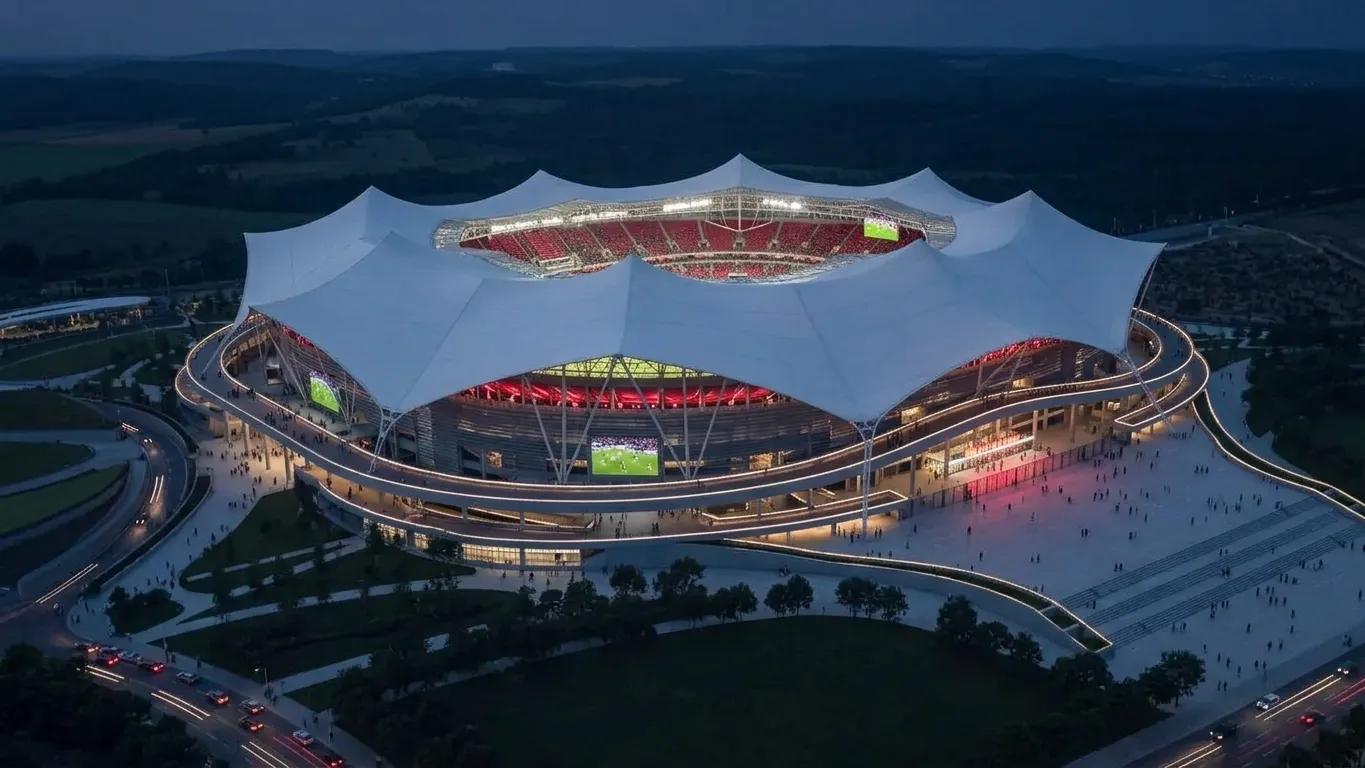
Grand Stade Hassan II: the 115,000-seat stadium near Casablanca — September 2026 construction progress, design, cost breakdown, transport, and the still-open question of hosting the 2030 World Cup final.
Grand Stade Hassan II: Capacity, Construction Progress & the 2030 World Cup Final
Grand Stade Hassan II is a 115,000-seat football stadium under construction in Benslimane Province, about 38 km north of Casablanca — set to become the largest purpose-built football stadium in the world when it opens at the end of 2027. Designed by Oualalou + Choi and Populous as a giant moussem tent spanning a cork-oak forest, it is Morocco's flagship venue for the 2030 FIFA World Cup, which the Kingdom will co-host with Spain and Portugal.
The build is visible and moving fast. In May 2026, Reuters reported the stadium roughly 30% complete with about 40% of the stands already built, working three shifts around the clock. By September 2026, concrete stands and tower cranes covered nearly the whole site, and a MAD 277.5 million contract went to tender for the first 114,414 seats.
The stadium also sits at the centre of the biggest unresolved question in world football: where the 2030 World Cup final will be played. Moroccan federation president Fouzi Lekjaa insists it "will" be Casablanca; FIFA says the decision will come "in due course"; and the choice may not land until after the FIFA Congress in Rabat in 2027. This guide tracks the numbers, the design, the construction progress, the financing, the transport, and the stakes around the 2030 World Cup.
For Morocco's other World Cup 2030 venues, see our complete stadiums guide, and for the city itself, our Casablanca city guide.
Quick Facts
| Feature | Details (September 2026) |
|---|---|
| Official name | Grand Stade Hassan II (ملعب الحسن الثاني), named for King Hassan II (r. 1961–1999) |
| Location | El Mansouria commune, Benslimane Province — ~38 km north of central Casablanca |
| Capacity | 115,000 design capacity / 114,414 contracted seats |
| Status | Under construction — earthworks from Aug 2024, main works since Jun 2025 |
| Target opening | End of 2027 (official); end of 2028 as the outer published estimate |
| Cost | MAD 5 billion official stadium budget; MAD 10 billion+ in awarded programme contracts |
| Owner | Royal Moroccan Football Federation (FRMF) |
| Operator | SONARGES — builds, operates and runs ticketing via the TADAKIR platform |
| Lead architects | Oualalou + Choi with Populous |
| Engineering team | Maffeis Engineering · ME Engineers · Rider Levett Bucknall |
| Main contractor | Moroccan consortium SGTM–TGCC (MAD 3.2bn main works) |
| Planned tenants | Morocco national team, Raja CA, Wydad AC |
| 2030 World Cup | Morocco's flagship venue — bidding to host the final |
Grand Stade Hassan II: Set to Become the World's Largest Football Stadium
If Grand Stade Hassan II is completed as designed, its 115,000 seats will make it the largest purpose-built football stadium ever constructed. No football-specific venue on Earth is currently planned at this scale.
The record needs one qualifier: several bigger stadiums exist, but they were built for other sports or as multi-use arenas.
| Stadium | Country | Capacity | Primary use |
|---|---|---|---|
| Narendra Modi Stadium | India | 132,000 | Cricket |
| Rungrado 1st of May Stadium | North Korea | ~114,000 | Multi-use |
| Michigan Stadium | USA | 107,601 | American football |
| Camp Nou | Spain | 99,354 (pre-renovation) | Football |
| Wembley Stadium | England | 90,000 | Football |
| Grand Stade Hassan II | Morocco | 115,000 | Football (under construction) |
Two caveats worth knowing. Vietnam has announced plans for a 135,000-seat VinFast Stadium that would surpass it, and Barcelona's Camp Nou expansion aims beyond 100,000 seats. But as things stand in late 2026, no football stadium anywhere matches what is rising in the Benslimane forest, making it one of the most closely followed sports projects ahead of the 2030 World Cup.
Construction Progress: September 2026 Update
The stadium passed a visible tipping point in 2026. Reuters, touring the site in May, reported the project about 30% complete with roughly 40% of the stands built, with crews working three shifts around the clock to hold the end-of-2027 opening target. Summer imagery showed the "giant tent" taking shape — concrete stands, large reinforced-concrete structures and cranes spread across nearly the entire 100-hectare site by September.
The most recent hard milestone: in September 2026, procurement agency ANEP opened bids for a MAD 277.5 million contract to install 114,414 seats — the first contracted seat count for the finished bowl.
| Date | Milestone |
|---|---|
| Jun 2023 | Project confirmed at a government council led by Head of Government Aziz Akhannouch |
| Oct 2023 | Morocco wins 2030 co-hosting; state financing agreement (~MAD 5bn, 2025–2028) signed with CDG |
| 14 Mar 2024 | Oualalou + Choi with Populous wins the international design competition |
| Aug 2024 | Design unveiled to the world press; first earthworks begin (SGTM, MAD 356M) |
| Jun 2025 | Main works awarded to SGTM–TGCC (~MAD 3.2bn) — the only consortium to pass both technical and financial criteria |
| May 2026 | Reuters: stadium ~30% complete, ~40% of stands built, three shifts, end-2027 target |
| Aug 2026 | New packages: MAD 2.68bn exterior works, MAD 763M outer shell, MAD 7.2bn surroundings development |
| Sep 2026 | MAD 277.5m tender for 114,414 seats — bids opened 23 September |
Delivery window: the official target remains end of 2027, roughly 60 months after the design consortium's appointment. StadiumDB, the most conservative tracker, notes the end of 2028 as the outer published estimate. No test-event schedule has been announced yet.
Why It Is Being Built in a Forest
The site surprises first-time visitors: not a city district, but ~100 hectares inside the Benslimane cork-oak forest, roughly midway between Casablanca and Rabat. The wider Benslimane forest covers 58,000 hectares — a quarter of the Casablanca-Settat region's wooded land — and the designers have leaned into that setting rather than clearing it.
The location is the project's second act. The original plan favoured Sidi Moumen, inside Casablanca, but the site did not pass geotechnical evaluation — soil weakened by a former stone quarry — and urban land was scarce. In 2017 a public-utility decree designated the Béni Amar plot near El Mansouria for expropriation with compensation. In 2019, the project was paused to re-examine its siting, financing and environmental constraints, following cost concerns and reservations raised in particular by the High Commission for Water and Forests. That period allowed the project and its territorial integration to be reassessed. When Morocco won 2030 co-hosting rights in October 2023, the project was relaunched and became the centrepiece of the Kingdom's World Cup bid.
Around the stadium, state operator SONARGES plans a wider "Morocco Sport City" complex: a 25,000-seat athletics stadium, an Olympic swimming pool, a convention centre, a shopping centre, a hotel and FIFA-standard training pitches — most of it contracted in later phases.
The Design: A Moussem Tent Over a Garden
The concept comes from Moroccan tradition. The stadium is inspired by the moussem — a traditional Moroccan and North African communal gathering held under large tents — combined with the imagery of the garden.
"The Grand Stade Hassan II is deeply rooted in Moroccan culture, with its traditions and contemporary expressions." — Tarik Oualalou, lead architect
Three design elements define it:
- A translucent aluminium lattice roof spanning the bowl and outer concourses — the "tent" visible from kilometres away
- 32 monumental stairways ringing the stadium, which do triple duty as structural supports for the roof, entrance gateways, and platforms for raised gardens 28 metres above the ground
- Botanical gardens at ground level beneath the canopy's outer edges, layering gardens, concourses and terraces so the boundary between stadium and park blurs
The architectural ambition is matched by engineering of the same scale: the consortium is completed by Maffeis Engineering (long-span structure specialists), ME Engineers (building systems) and Rider Levett Bucknall (cost management), with a global delivery period fixed at 60 months. Sustainability runs through shade and natural ventilation from the open-but-covered concourses; no formal certification target has been published.
Inside the Bowl: Where the 115,000 Seats Go
The seating plan is built for atmosphere, not just volume:
115,000
design capacity
114,414
contracted seats
3
tiers per end
32
garden gateways
Illustrative layout — not an official plan. No official seat map has been published for Grand Stade Hassan II yet. The published facts are: 29,500 seats per end, 12,000 hospitality seats across both sides, five hospitality levels per main stand, and a ring of 32 stairways with raised gardens ~28 m above ground. The 8-sector arrangement and tier splits shown here are an illustrative model reconciling those figures to the 115,000 design capacity.
- Behind each goal: three steep, compact tiers holding 29,500 spectators per end — 59,000 of the noisiest seats in world football, designed as dedicated zones for Raja and Wydad's fiercest supporters
- Along the sides: five levels of hospitality on each main stand — 12,000 VVIP, VIP, box and hospitality seats in total across both sides, including the royal box
- The remaining ~44,000 seats are general-admission side-tier seating outside the hospitality levels
Worth noting: the published figures above account for 71,000 seats; the full official breakdown of the remaining side-tier seating has not been released. The contracted total from the September 2026 seating tender — 114,414 seats — is the most precise number published to date, against the round 115,000 design capacity.
How to Get to Grand Stade Hassan II
Transport for this stadium is rail-first — unusual for a venue in a forest, and essential for moving six-figure crowds.
| From the dedicated Grand Stade Hassan II station | Travel time |
|---|---|
| Central Casablanca | ~15 minutes |
| Rabat | ~20 minutes |
| Mohammed V International Airport | ~20 minutes |
- Rail: The station sits on Line 1 of Casablanca's new RER (the "Train Métropolitain de Proximité", a MAD 20bn, 92 km network launched in September 2025), with an Al Boraq high-speed rail interchange. The station itself — built by Jet Contractors for ~MAD 415.5 million — is sized for around 12 million passengers a year. Full RER service is targeted for November 2029, months before the World Cup.
- Road: A MAD 605 million motorway program adds a new A7 (Casablanca–Rabat) interchange and doubles and triples the connecting regional roads.
- Parking: Four outer zones provide 10,463 parking spaces across 261,321 m².
Airport note — a common mistake: there is no new airport at Benslimane in current plans. The old Benslimane airfield is being repurposed for military maintenance hangars. Morocco's actual new-airport project is the expanded Mohammed V terminal at Nouaceur (targeting ~20 million passengers by end-2029), which connects to the stadium by the rail line above — not by adjacency.
What It Costs — and Who Is Paying
The figure that matters depends on which scope is being quoted, since different contracts cover different parts of the project. All of these figures are real, but they don't cover the same scope and shouldn't be added together:
| Scope | Figure |
|---|---|
| Official stadium budget (Government–CDG agreement, 2025–2028) | ~MAD 5 billion |
| Main structural works contract (SGTM–TGCC) | ~MAD 3.2 billion |
| Roof and facade package | ~MAD 3.77 billion |
| Exterior works | ~MAD 2.68 billion |
| Lighting and broadcast systems | ~MAD 2.25 billion |
| Surroundings development | ~MAD 7.2 billion |
| Seats (114,414) | MAD 277.5 million |
| Cumulative awarded contracts visible in 2024–2026 procurement | MAD 10 billion+ |
| Reuters framing (stadium + surroundings) | "roughly $1 billion" |
Governance is a four-way structure: ANEP runs procurement for the state, CDG (Caisse de Dépôt et de Gestion) provides the financing, the FRMF owns the venue, and SONARGES builds and will operate it. Notably, the construction wave has been won largely by Moroccan contractors — SGTM and TGCC also landed the new Mohammed V airport terminal — underscoring the growing role of major Moroccan firms in the Kingdom's infrastructure projects.
As with any major infrastructure project, the programme sits within a broader public debate over investment priorities — a debate sharpened in 2026 by cost-of-living protests, with part of the French-language press referencing a "two-speed Morocco." Project backers point to a concrete counterargument: unlike many World Cup stadiums left without a clear post-tournament use, Grand Stade Hassan II already has a planned second life as the shared home of Raja and Wydad. On that basis, architect François Clément of Populous has rejected the white-elephant label: "Le Grand Stade Hassan II ne sera pas un éléphant blanc."
Will the 2030 World Cup Final Be Played Here?
No official decision has been announced, and in September 2026 the question took on a diplomatic dimension.
On 10 September, FRMF president Fouzi Lekjaa said at a rally that he hoped "Benslimane Province will have the honor of hosting the 2030 World Cup final," adding he'd like to see a Morocco–France final. FIFA responded the same day that the decision "will be made in due course," and Head of Government Akhannouch urged caution, noting the matter hadn't yet been discussed with co-hosts Spain and Portugal. In Spain, federation chief Rafael Louzán has made the case for his own country to host the final, pointing to the 1982 final as precedent.
| The two bids | Morocco | Spain |
|---|---|---|
| Venue | Grand Stade Hassan II (115,000) | Santiago Bernabéu (~78–83,000) or Camp Nou |
| Main argument | World's largest football stadium, delivered on schedule | 1982 final pedigree, proven operations |
| Backstory | Second World Cup final in Africa after 2010 | Louzán invokes Spain's champion status |
The realistic decision window is after the FIFA Congress in Rabat in 2027, with reporting tying the timing to FIFA president Gianni Infantino's March 2027 re-election. One British press report even claimed Infantino offered Morocco the final in exchange for electoral backing — a report FIFA called "false and misleading." Until FIFA decides, any claim that the final is confirmed — in Casablanca or Madrid — is premature.
The 2025 AFCON context is also part of the discussion around 2030 organisational capacity. The contested AFCON 2025 final — abandoned, then awarded to Morocco 3–0 by forfeit, and now heading to a CAS hearing reported for October 2026 — has been weaponised by Spain against Morocco's organisational case, while Morocco counters with delivery: a new 69,500-seat Prince Moulay Abdellah stadium opened on time in 2025, and Hassan II is on track.
After 2030: Raja, Wydad and the 115,000-Seat Question
When the World Cup leaves, the stadium becomes the intended shared home of the Morocco national team, Raja CA and Wydad AC — the two Casablanca giants leaving the historic Complexe Mohammed V for a venue more than twice its size.
Long-term fill-rate will naturally be an important question: a 115,000-seat capacity exceeds the usual needs of a league match. The realistic anchors are the Casablanca derby, national-team matches, CAF finals and concerts — with SONARGES marketing the venue as a year-round event hub through its TADAKIR ticketing platform. For the surrounding province, the build has already triggered a real-estate and planning boom around Benslimane, with several thousand workers mobilised on site across three daily shifts.
Grand Stade Hassan II vs Morocco's Other 2030 Stadiums
Morocco's World Cup plan uses six match venues. Five exist today; one is rising in Benslimane:
| Stadium | City | Capacity | Status |
|---|---|---|---|
| Grand Stade Hassan II | Casablanca (Benslimane) | 115,000 | New — opening end-2027 |
| Prince Moulay Abdellah | Rabat | 69,500 | New — opened September 2025 |
| Ibn Batouta | Tangier | 75,500 | Renovated |
| Grand Stadium of Fez | Fez | 55,800 | Renovated |
| Adrar Stadium | Agadir | 46,000 | Renovated |
| Grand Stadium of Marrakech | Marrakech | 45,860 | Renovated |
Casablanca's beloved Complexe Mohammed V — renovated in 2024–25 to ~44,000 seats — is slated as a 2030 training venue rather than a match stadium, with the new Grand Stade taking the city's World Cup slot.
Frequently Asked Questions
When will Grand Stade Hassan II be completed? The official opening target is the end of 2027. Reuters reported the stadium about 30% complete in May 2026 with three shifts working around the clock, and StadiumDB notes the end of 2028 as the outer published estimate. No test-event schedule has been announced yet.
What is the capacity of Grand Stade Hassan II? 115,000 is the design capacity. The September 2026 seating tender contracts exactly 114,414 seats. Each end holds 29,500 spectators, hospitality accounts for 12,000 seats across both main stands, and the remaining ~44,000 are general side-tier seats.
Where is Grand Stade Hassan II located? In El Mansouria commune, Benslimane Province, about 38 km north of central Casablanca — roughly midway between Casablanca and Rabat, inside a cork-oak forest. It is not in Casablanca proper, and not next to any airport.
What is the current progress of the Grand Stade Hassan II project? As of September 2026: about 30% overall completion (May 2026, Reuters), roughly 40% of stands built, concrete structures and cranes across nearly the whole site, and the 114,414-seat installation contract at tender stage with bids opened on 23 September 2026.
Will the 2030 World Cup final be played at Grand Stade Hassan II? Undecided. Morocco's federation president has declared the final "will" be in Casablanca, but FIFA says the decision will be made "in due course," with the realistic window after the FIFA Congress in Rabat in 2027. Spain is pushing the Santiago Bernabéu. No host for the final has been confirmed.
Who designed Grand Stade Hassan II? Lead architects Oualalou + Choi (Paris/Casablanca) with Populous, supported by engineering firms Maffeis Engineering, ME Engineers and Rider Levett Bucknall. They won the international design competition on 14 March 2024.
How much will Grand Stade Hassan II cost? It depends on scope: the official stadium budget is about MAD 5 billion; awarded contracts across the stadium and its surroundings already total more than MAD 10 billion; and Reuters frames the stadium-plus-surroundings programme at roughly $1 billion.
Which teams will play at Grand Stade Hassan II? The Morocco national team and both Casablanca clubs, Raja CA and Wydad AC, are the intended tenants after 2030, replacing the Complexe Mohammed V. No lease terms have been published.
Was Grand Stade Hassan II used for AFCON 2025? No. AFCON 2025 (December 2025–January 2026) was played in nine existing venues. The new stadium was never part of that tournament — it will be ready for the 2030 World Cup cycle.
Is Grand Stade Hassan II the same as the Hassan II Mosque? No. They share only their namesake, King Hassan II. The mosque is Casablanca's famous seaside landmark inside the city; the stadium is a new build 38 km north in Benslimane forest.
How will fans get to the stadium? Mostly by rail: a dedicated Grand Stade Hassan II station on Casablanca's new RER Line 1 puts the stadium about 15 minutes from central Casablanca, 20 from Rabat and 20 from Mohammed V airport. There are also 10,463 parking spaces and an upgraded A7 motorway interchange.
Last updated: September 2026 | Sources: Populous, Reuters, StadiumDB, ANEP procurement reporting (Medias24, Le360), Morocco World News, ESPN, Wikipedia (EN/FR)
In this article
- Grand Stade Hassan II: Capacity, Construction Progress & the 2030 World Cup Final
- Quick Facts
- Grand Stade Hassan II: Set to Become the World's Largest Football Stadium
- Construction Progress: September 2026 Update
- Why It Is Being Built in a Forest
- The Design: A Moussem Tent Over a Garden
- Inside the Bowl: Where the 115,000 Seats Go
- How to Get to Grand Stade Hassan II
- What It Costs — and Who Is Paying
- Will the 2030 World Cup Final Be Played Here?
- After 2030: Raja, Wydad and the 115,000-Seat Question
- Grand Stade Hassan II vs Morocco's Other 2030 Stadiums
- Frequently Asked Questions
Written by
Morocco Stadiums Team
Morocco Stadium Guide